Inside My Panama Art Studio
My studio sits in El Valle de Antón, Panama, surrounded by the kind of landscape that continually finds its way into my work: dense tropical foliage, changing mountain light, brilliant birds, sudden rain, and the persistent sense that nature is always growing, shifting, and reclaiming space.
It is where most of my paintings begin.
Not necessarily with a finished composition in mind, but with a color, a gesture, an animal, a photograph, a memory, or an idea I cannot quite stop thinking about.
My work explores transformation, visibility, expression, and the courage it takes to grow into a fuller presence. Living and working in Panama has given me a visual language for those ideas. Trees become symbols of rootedness and expansion. Rivers suggest release. Dense vegetation can conceal or protect. A jaguar can embody power. A butterfly can mark a moment of transition.
In the studio, those ideas gradually become paintings.
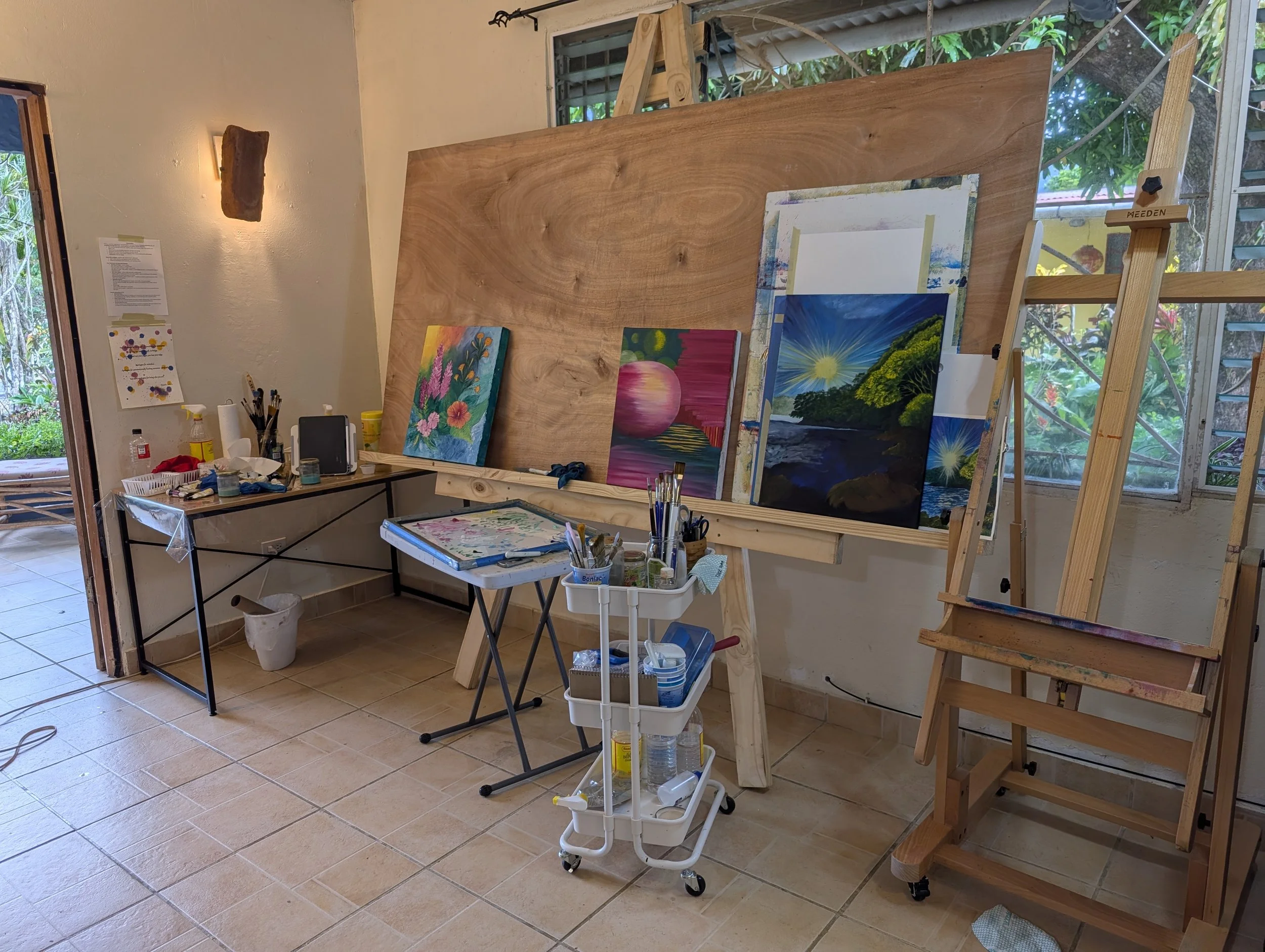
A look inside the art studio of Andrea Grimm in Panama
A Studio Built Around Making
My studio is part workspace, part laboratory, and part refuge.
I work across several media, so the room changes depending on what I am creating. Some days, large canvases are leaning against the walls and tubes of acrylic paint cover my work surface. On others, I am working more quietly with watercolor, Caran d'Ache watercolor crayons, drawing materials, or digital sketches in Procreate.
I like having my materials visible and accessible. Golden acrylics, Daniel Smith watercolors, Caran d'Ache crayons, brushes, pencils, paper, reference photographs, color studies, and unfinished experiments all become part of the landscape of the studio.
There is usually more than one painting in progress.
I often need to move back and forth between pieces. Stepping away from one painting and working on another gives me enough distance to see what the first one actually needs.
Sometimes the most productive thing I can do for a painting is stop looking at it.
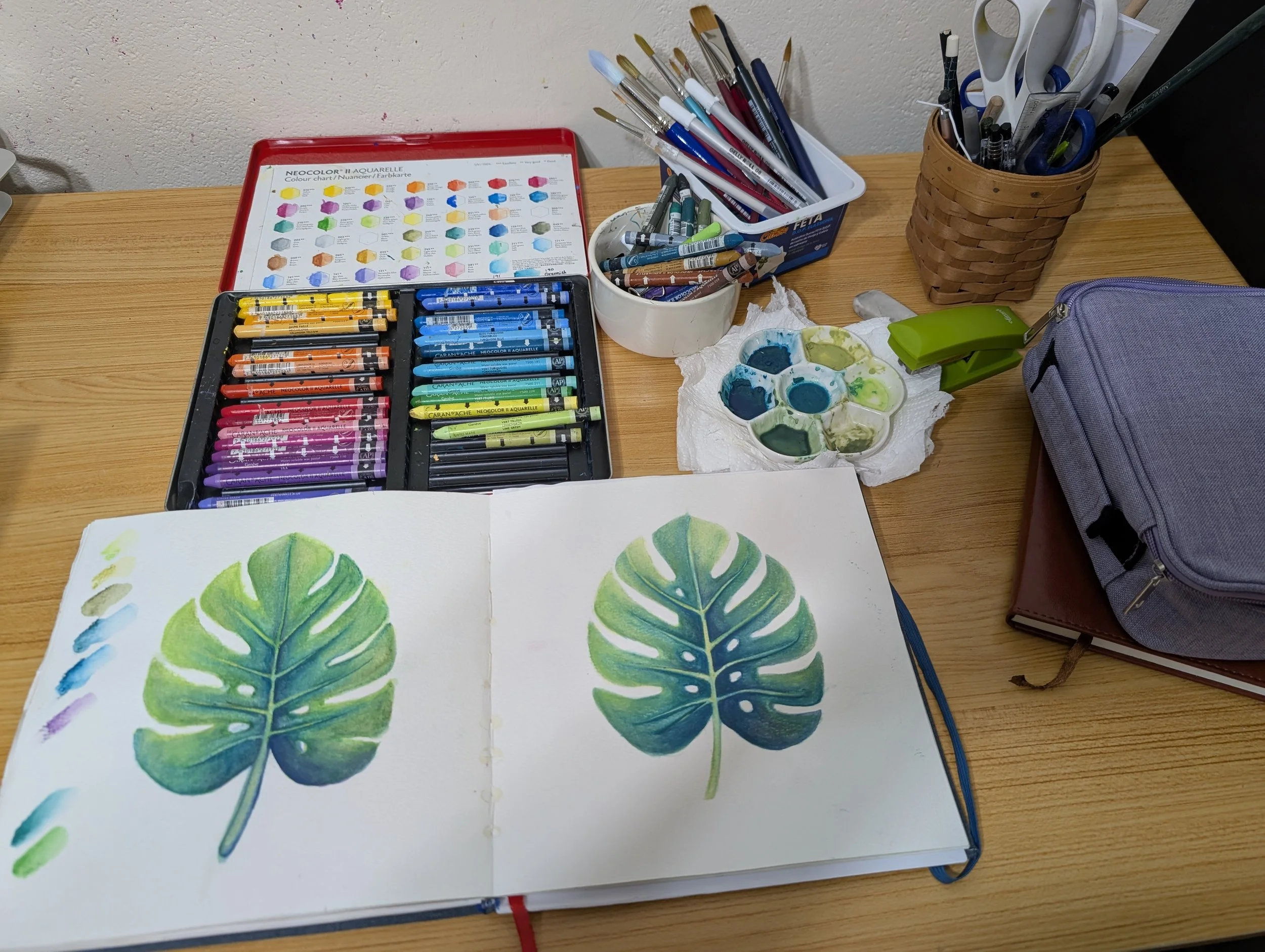
Painting Monstera leaves with Caran d’Ache watercolor crayons
Where the Paintings Begin
My paintings rarely begin with the question, What would look beautiful on a wall?
They usually begin with something less comfortable.
What does it feel like to make yourself smaller?
What happens when someone finally decides to be seen?
What does suppressed emotion look like before it breaks open?
How do you paint the moment between fear and expansion?
Those questions have led me again and again to imagery from the natural world.
A figure may disappear into a forest.
A river may cut through a body.
A tree may grow through a human form.
A jaguar may emerge from shadow.
What begins as an image eventually becomes a visual metaphor.
That is the part of painting I find most compelling: discovering how formal elements—color, value, scale, movement, texture, edge, and composition—can carry psychological meaning without requiring a literal explanation.
Panama as a Visual Vocabulary
It would be impossible for me to work here without Panama entering the paintings.
The landscape of El Valle is especially influential. The mountains surrounding the volcanic crater can disappear into mist and emerge again within hours. Tropical plants grow with an almost unreasonable determination. Birds flash through the trees in colors that seem invented. Waterfalls, rivers, orchids, Cecropia leaves, butterflies, toucans, hummingbirds, sloths, and jaguars all provide an extraordinary vocabulary of forms.
But I am less interested in simply documenting them than in asking what they can represent.
The natural world in my paintings often mirrors an interior one.
A tree can represent slow, deliberate growth.
A clearing can suggest the possibility of becoming visible.
A river can become emotional release.
A powerful animal can represent an aspect of ourselves that has been restrained, feared, or forgotten.
Nature gives me a way to talk about human experience without illustrating it too literally.
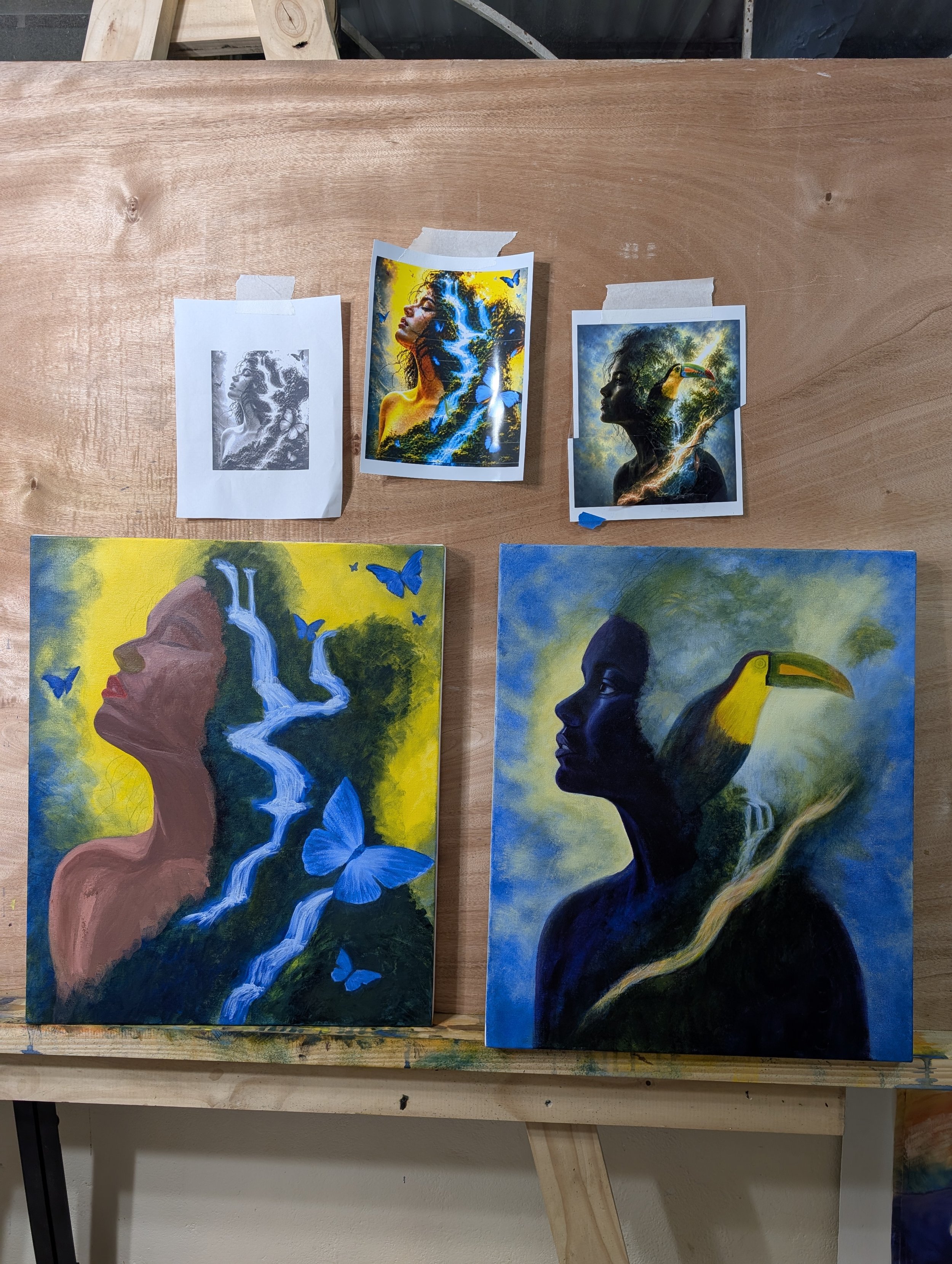
Two paintings in progress from the Expression series on the wall easel.
Color Is Often the First Decision
Before I begin a painting, I frequently establish a limited palette.
I am drawn to colors that feel organic but emotionally charged: deep greens, muted turquoise, ultramarine and Prussian blues, earthy oxides, violet, magenta, ochre, and occasional bursts of tropical color.
I rarely want every color to compete for attention.
Instead, I think about hierarchy.
Where should the eye go first?
Where does the painting need quiet?
Where does it need tension?
Where does the color need to break through?
Those decisions happen throughout the painting process. Even when a work looks spontaneous, there is usually a great deal of editing beneath that spontaneity.
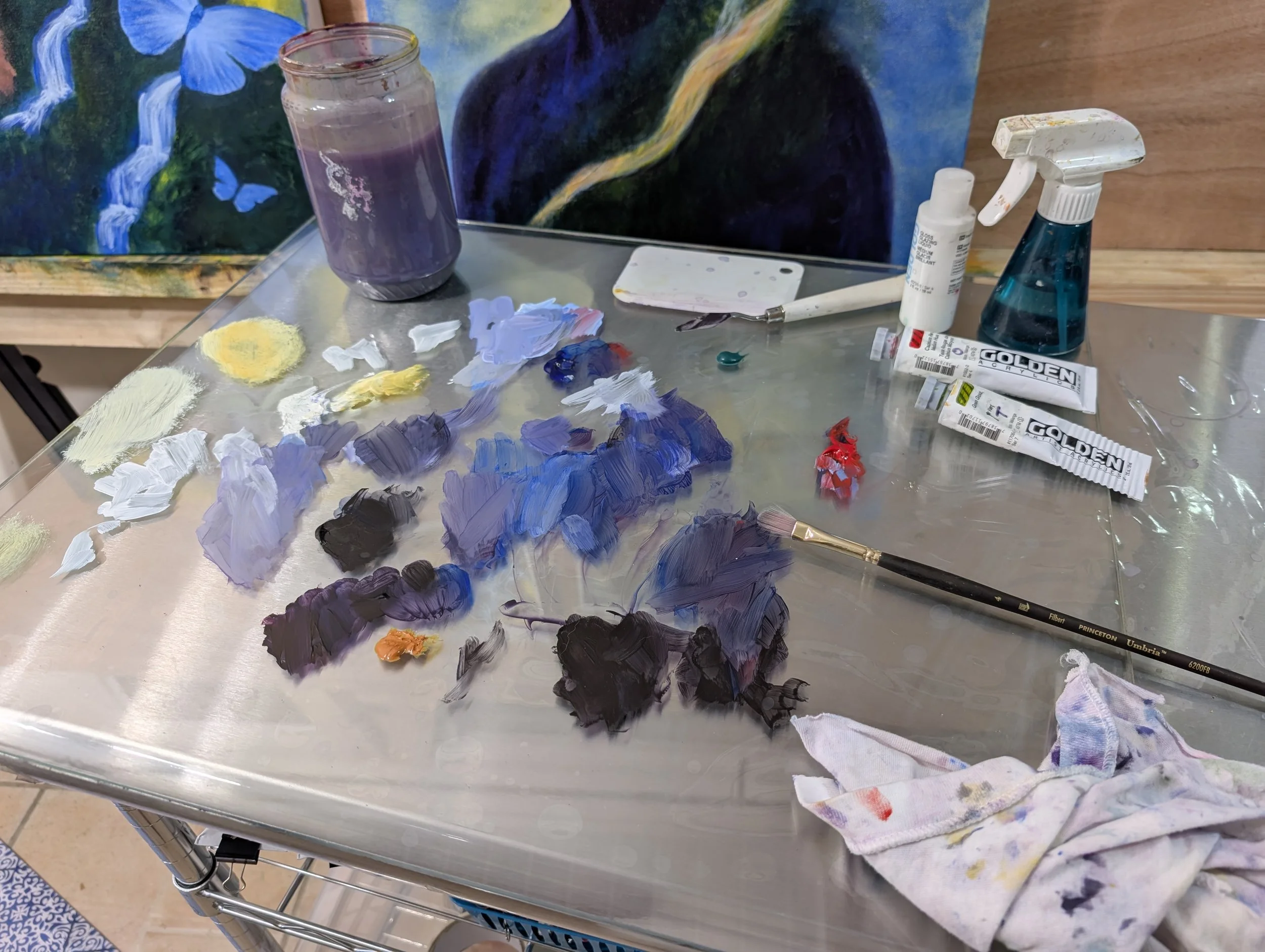
Paint palette with Golden acrylic paints
The Messy Middle
There is a stage in almost every painting when I become convinced I have ruined it.
It is remarkably consistent.
The original idea has disappeared, the painting has not yet found its final structure, and every decision seems to expose another problem.
I have learned not to fear that stage quite as much.
Often, it means the painting is moving away from the safe solution.
I scrape things away. Paint over passages I once liked. Change the value structure. Remove details. Add larger shapes. Turn the canvas. Photograph it. Look at it on a screen. Walk across the room and look again.
Painting becomes less about adding and more about deciding what deserves to remain.
That process of revision is important to the meaning of my work as well.
Growth is rarely a clean progression. Neither is painting.
Analog and Digital Tools
Although I am primarily a painter, digital tools are also part of my studio practice.
I use Procreate to experiment with composition, test proportions, change color relationships, explore variations, and work through ideas before committing them to canvas.
I do not see this as separate from traditional painting.
For me, it is simply another sketchbook.
Digital studies allow me to ask, What if? very quickly.
What if the river were wider?
What if the figure moved farther into shadow?
What if the landscape became more abstract?
What happens if the focal point shifts?
Some ideas remain digital experiments. Others become paintings. Occasionally the final painting bears almost no resemblance to the first sketch, which is usually a sign that something interesting happened along the way.
Living With Unfinished Work
An artist's studio is one of the few places where unfinished things are allowed to remain unfinished.
I value that.
There are canvases waiting for solutions, sketches that may become something years from now, color studies, failed experiments, and fragments of ideas I have not yet learned how to use.
They are not necessarily abandoned.
They are part of an ongoing conversation.
One painting frequently teaches me how to resolve another. A botanical study may become the foundation of a larger figurative work. A landscape experiment may introduce a color relationship that appears months later in an entirely different series.
The studio allows those connections to accumulate.
What I Hope Leaves the Studio
Eventually, a painting stops belonging entirely to me.
It leaves the studio and enters someone else's home.
At that point, the viewer brings their own experiences to it, and I think that is where a work of art becomes most interesting.
I do not need someone to interpret a painting exactly as I do.
I would rather they recognize something of themselves in it.
A sense of resilience.
Release.
Quiet strength.
The possibility of taking up more space.
Or simply the recognition that growth can be slow, complicated, beautiful, and worth choosing.
That is what I hope begins here in my Panama studio—and continues long after the painting leaves it.
